Oregon in Four Years · Part 4
Oregon in Four Years, Part 4: Will You Be Better Off?
On my three health measures, the honest answer is the same under either candidate. By the end of the next term Oregon will most likely be about 31st–34th on Jobs, 37th on Safety and 45th on Schools. Jobs improves under either winner, mostly through mean reversion. Safety and Schools stay put.
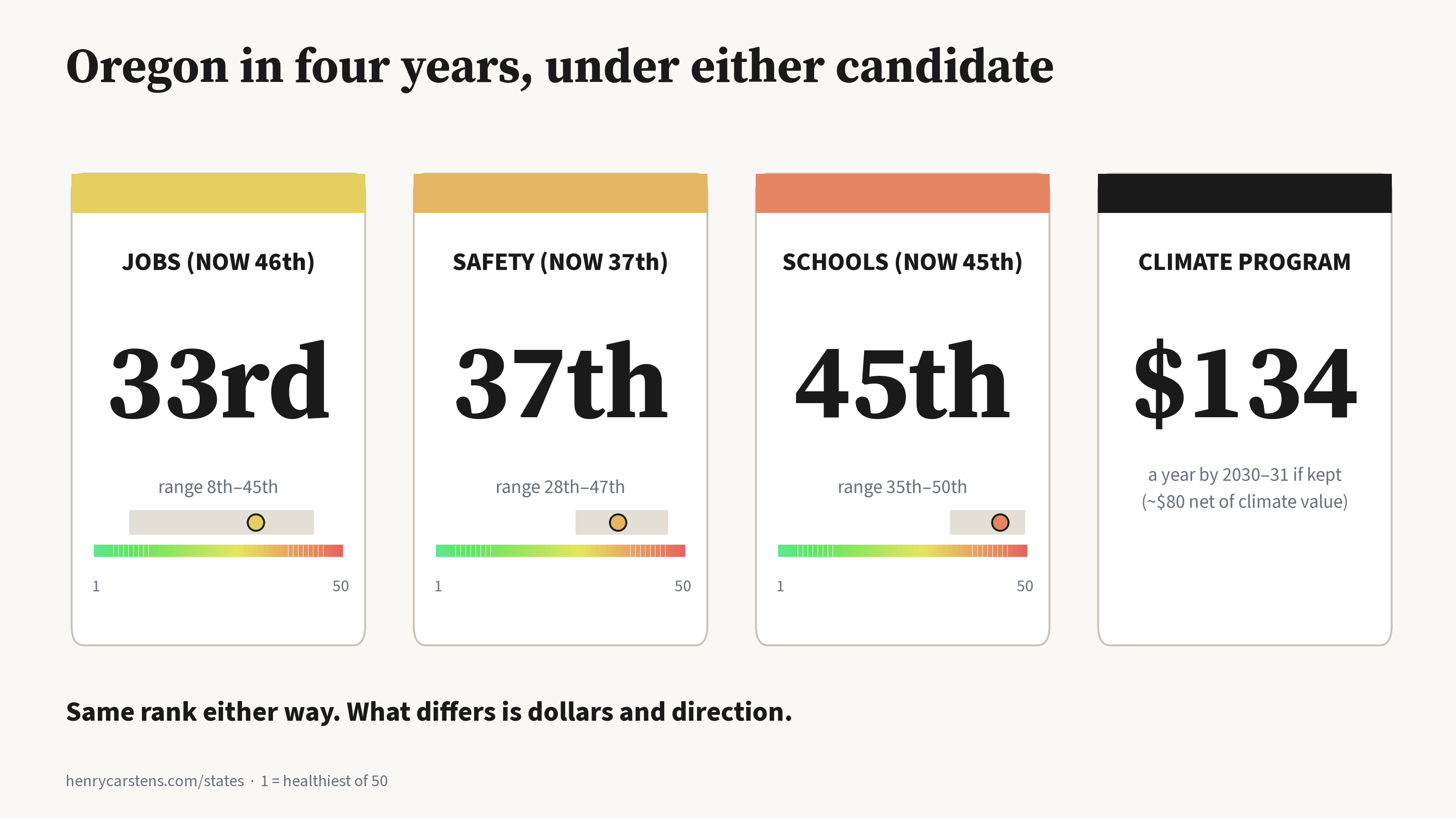
Bottom line: On my three health measures, the honest answer is the same under either candidate. By the end of the next term Oregon will most likely be about 31st–34th on Jobs, 37th on Safety and 45th on Schools. Jobs improves under either winner, mostly through mean reversion. Safety and Schools stay put. The gaps between Kotek and Drazan are all about a sixth of the noise or less, and every gap's range includes zero. So there is no distinguishable difference on any pillar. What does differ is money (the climate program and taxes), who decides (the Legislature matters as much as the governor), and which school habits Oregon builds for the 2030s.
The method in one line
Forecast = the shared baseline (the national trend plus Oregon's usual gap, from the site's backtested forecast) + a small governor effect. Each lever's effect = chance it passes, given who holds the Legislature × chance it's in place before the last data of the term × effect size from a named study. Levers with no measured effect size count as zero. They're listed in the ledger, not hidden. Where the 80% range of the Kotek–Drazan gap includes zero, I say "no distinguishable difference."
That starts from what this site already said: "the best guess for Oregon's rank three to five years out is today's rank" and "Five years won't bring it back to the middle." The research agrees. Dynes & Holbein (2020) found 82 of 84 party effects on state outcomes were statistically zero. Leigh (2008) found governors "behave in a fairly non-ideological manner."
The grid: candidate × who holds the Legislature
Expected rank on the last data of the term (Jobs and Safety: 2029 data; Schools: NAEP 2030). 1 = healthiest.
| Legislature after Nov 3 | Kotek: Jobs · Safety · Schools | Drazan: Jobs · Safety · Schools | Distinguishable? |
|---|---|---|---|
| Democrats keep 3/5 in both chambers | 34th · 37th · 45th | 32nd · 37th · 45th | No · No · No |
| Democrats keep majorities, lose 3/5 | 33rd · 37th · 45th | 32nd · 37th · 45th | No · No · No |
| Republicans win a chamber | 33rd · 37th · 45th | 31st · 37th · 45th | No · No · No |
| Today | 46th · 37th · 45th | ||
| Noise if nothing changes (80% range) | 8th–45th · 28th–47th · 35th–50th |
How big each gap is, measured against the noise:
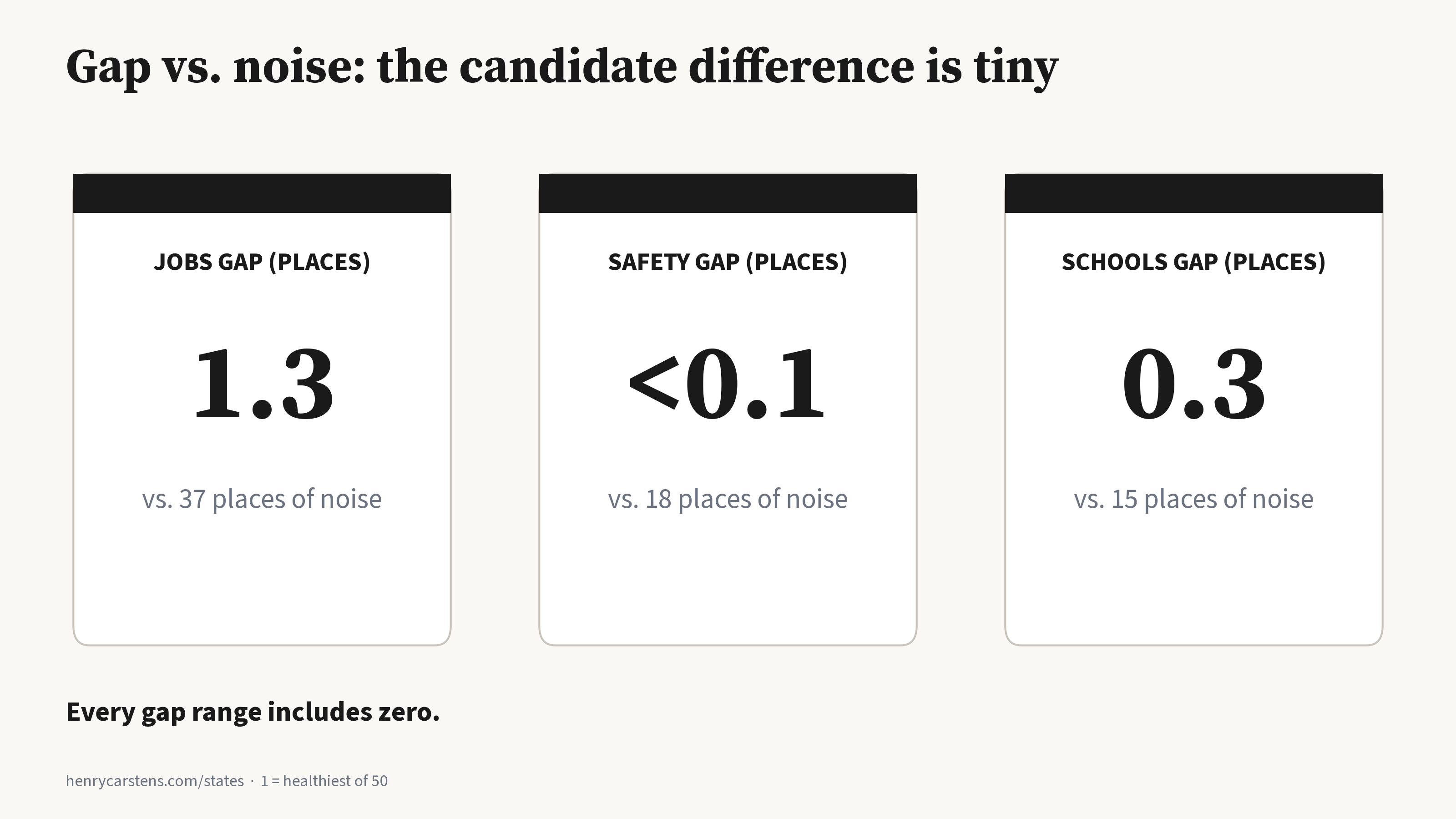
- Jobs: Drazan leans about 1–2 places ahead (0 to about 6 in the 80% range). That rests on one lever, a business tax cut whose size I had to assume, and which a Democratic Legislature would probably block. Leigh's close-election evidence points the other way, with about 0.3 points lower unemployment under Democratic governors. When two credible methods disagree on the sign, the safe call is zero.
- Safety: a few hundredths of a place. Moving Oregon 4 places by policing alone would take about 57% more police. Neither proposes that.
- Schools: under 1 place either way. The 2030 test comes one to two school years after any 2027 law takes effect.
What the governor actually controls (the timing)
- Jan 2027: the new governor takes office and revises Kotek's last budget (ORS 291.222; due to legislators by Feb 1, 2027).
- 2027 long session (up to 160 days): this is where nearly every lever lives. Taxes need three-fifths of each chamber (Oregon Constitution Art. IV §25). Democrats hold 37/60 in the House (one above the 36 needed) and exactly 18/30 in the Senate (Ballotpedia, Oct. 2026), so one lost Senate seat ends that. Overriding a veto needs two-thirds, which Democrats don't have, so a Drazan veto sticks. But the Legislature can refer a measure to voters, and the governor can't veto that (Art. IV §1(3)(c)).
- Laws take effect in 2028. The data that grades the term comes out in 2029–30: Jobs and FBI data for 2029, and NAEP 2030 in fall 2030. That's too soon for most levers.
- Late 2028: the governor writes the 2029–31 budget. That's the first budget fully her own, and it pays out mostly after the term's last data.
Reed (2006) finds that taxes follow the party running the Legislature, about 0.3–0.5 points of income more under 5 years of Democratic control. Governor party adds nothing measurable. So on taxes, the Nov. 3 legislative races matter about as much as the governor's race.
What does move
-
The climate program (CPP). Under Kotek it stays. My energy analysis puts the program's cost to Oregonians at about $134 per Oregonian per year by 2030–31, or about $80 net after counting its climate value (range: $170 worse to $90 better). Drazan promises to repeal it. It's a rule of the Environmental Quality Commission (EQC), not a law. A governor can remove commissioners, but their replacements need Senate confirmation (ORS 468.010), and a Democratic Senate could stall them. I put the chance a repeal is in force by 2029 at 60–85%, depending on the Senate. That's my judgment. So the expected saving under Drazan is roughly $80–$114 per person a year by 2030–31, before counting climate value. This is the clearest dollar difference in the race, and it doesn't show up in my Jobs rank (energy prices vs. Jobs rank: ρ = −0.11).
-
The direction of taxes. With Democrats keeping three-fifths, Kotek can sign new revenue for preschool and school time. Drazan would veto new taxes, and her cuts to the Corporate Activity Tax and estate tax need a Legislature that's likely Democratic. The likely Drazan-era outcome is fewer new taxes, not big cuts, unless Republicans win a chamber.
- School choice. Drazan can opt Oregon into the federal scholarship tax credit on her own (Kotek opted out in June 2026). That's direct for families eyeing private school. It isn't a score effect.
- Data centers. Both say they favor a moratorium, but they differ on scope. Kotek has paused data center requests for state-owned land (Sept. 8) and new air and water permits for new or expanded data centers (Oct. 9), both through July 1, 2027. She says a statewide ban needs the Legislature (Governor's Office, Sept. 8, 2026; OPB, Oct. 13, 2026). Drazan told newspaper publishers in July she opposed "an arbitrary moratorium." In September she said "Tina should issue a moratorium immediately" (The Oregonian, Sept. 2026) and told KATU she supports an immediate statewide moratorium, with no new development until there is enough power on the grid, water and farmland are protected, and host communities get benefits (KATU, Sept. 2026). For host towns like Boardman in Morrow County, each 100 MW delayed costs about $9 million a year (an upper bound from my data-center analysis).
- Protest unrest (no difference). Oregon likely stays #1 in protests with reported injury or damage, about an 85% chance either way (about 47% if it stays as quiet as 2023–24). The drivers are federal (ICE enforcement, the 2028 election) and local (Portland police, the Multnomah DA). The candidates differ on posture, not on the number. See Part 2.
- Prisons vs. treatment. Drazan's penalties would likely add prisoners. Kotek leans toward treatment capacity. Neither changes the index crime rank.
- Direction for 2030 and beyond. This is the real stake in Schools. Kotek's bet is more time + attendance + literacy. Drazan's adds a 3rd-grade gate and choice. Either bet, sustained for a decade, could be worth several places. Mississippi gained about a quarter of a standard deviation in 4th-grade reading in six years and climbed from 50th to 26th by 2024. Nobody will be able to grade this in 2030. The first fair read is NAEP 2032–2034.
What it would take (the short version; full piece in Part 5)
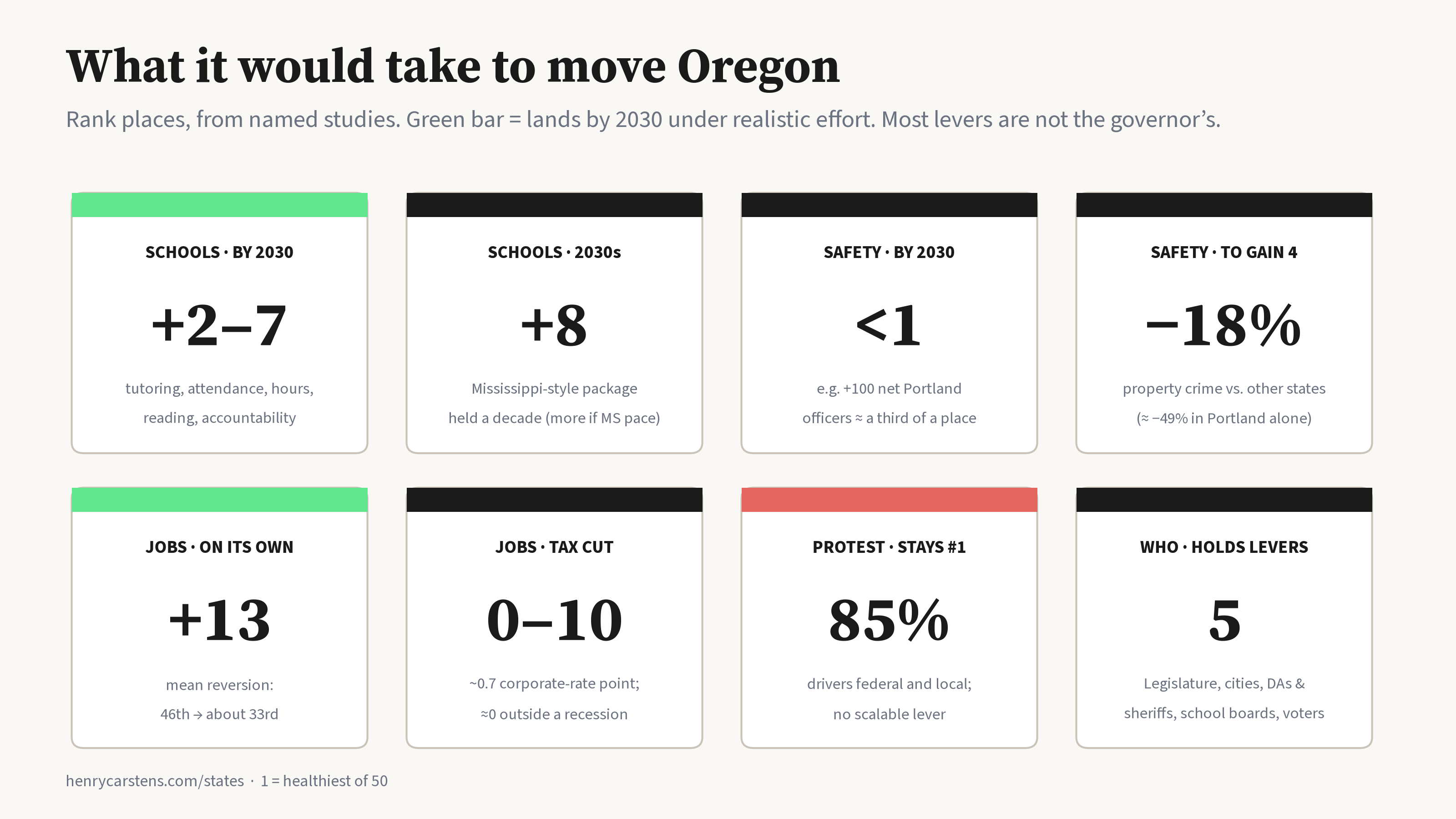
The governor's race barely moves the ranks, but other people can: - Schools (the Legislature, State Board, school boards and superintendents): the best-evidenced levers are high-dosage tutoring (1–2 places by 2030), cutting absences (1–2) and more school hours (0–2). A reading package with a 3rd-grade gate and accountability with consequences are the big 2030s prizes; Mississippi is the model. Together, started in 2027: 2–7 places, to about 38th–43rd. The money question is about where it goes, not how much: spending rose 89% since 2013 (5th fastest; now 19th of 50) while scores fell faster than in 45 other states, and only 55% of it reaches instruction. Repurpose, don't add: shifting about $216–364M a year from overhead into classrooms would pay for tutoring and more hours with no new taxes (Oregon Spent 89% More on Schools. Scores Fell to 45th.). - Safety (mayors, councils, DAs, sheriffs): 300 more Portland officers would be worth about 1 place, and at today's net hiring of +25 a year that takes about 12 years. Gaining 4 places needs property crime to fall 18% faster than in other states, or 57% more police statewide. Under 1 place is realistic by 2030.
- Jobs (the Legislature, cities): mean reversion already takes Oregon from 46th to about 33rd. A business tax cut worth about 0.7 of a corporate-rate point could add up to 10 places at the most generous estimate, but near 0 outside a recession.
- Voters (the 2028 ballot) and several governors in a row: the big climbs took 7–13 years.
So, will you be better off?
- On jobs, safety and schools, as measured: probably a little better on Jobs and the same on the other two, whoever wins. Vote on these if you like, but not on the promise of a different 2030 rank.
- If you drive a lot or heat with gas: Drazan's repeal of the climate program would likely save you money by 2030–31, if it sticks. Kotek's answer is that the program buys real emissions cuts. My estimate is that those are worth less than they cost.
- If you run a business: a Drazan Corporate Activity Tax cut is real money if it passes (25–70% chance, depending on the Legislature). The rank effect is small.
- If you're a lower-wage or Black worker: Beland (2015) finds Democratic governors narrow Black–white earnings gaps by about 5%, mostly by getting more people working, though average earnings slip. It's an average of many states, not an Oregon forecast.
- If you have young kids: Kotek's childcare and preschool path, and either candidate's time pledges, matter more for your kids than for the 2030 rank.
The biggest uncertainties
- The Legislature result (Nov. 3). It isn't known yet, and it decides most of the levers.
- A recession in 2027–29. It would swamp any lever, and it's the one case where tax cuts help more.
- Federal money. The 2025 federal law's Medicaid changes are expected to cost Oregon more than $400 million over two years (Capital Chronicle). That squeezes schools and treatment under either governor.
- NAEP 2026 (out winter 2027) resets the Schools baseline before the term starts.
- Data quirks. Late-booked business closures in the Jobs data, and gaps in FBI reporting coverage.
- My own bands. The "80%" ranges held 65–75% of the time in real-time tests.
What would prove me wrong
If, by the 2029 data, Oregon's Jobs rank under one governor beats the shared baseline by more than 10 places, or its property-crime rank moves 5 or more places, and a specific lever can be traced to it, then my priors on governors were too tight. I'll say so.
Sources: see Parts 1–3; plus my CPP cost-benefit analysis (Oct. 2026); ORS 468.010; Oregon Capital Chronicle, Oct. 13, 2026.
Oregon in Four Years
- Oregon in Four Years, Part 1: Jobs. Who Wins Matters Less Than You Think
- Oregon in Four Years, Part 2: Safety. The Gap Is a Rounding Error
- Oregon in Four Years, Part 3: Schools. The Test Comes Too Soon
- Oregon in Four Years, Part 4: Will You Be Better Off? (this page)
- Oregon in Four Years, Part 5: What It Would Take
- Opinion: What Would Make This Election Matter to the Middle of Oregon
- Oregon Spent 89% More on Schools. Scores Fell to 45th.
--h
Questions or corrections? Write me at .