Opinion
Opinion: What Would Make This Election Matter to the Middle of Oregon
My forecast finds no distinguishable difference between Kotek and Drazan on jobs, safety or schools by 2030. That could change if either candidate committed to a few measurable levers that land within one term.
Opinion. This is my view, built on my Oregon in Four Years forecast series.
I spent the past few weeks forecasting Oregon's next four years under each candidate for governor. Under Tina Kotek or Christine Drazan, Oregon ends the term about where it starts. Jobs moves from 46th to about 31st–34th, mostly because bad years tend to drift back toward average. Safety stays 37th. Schools stay 45th. Every gap between the candidates is about a sixth of the noise or less, and every gap's range includes zero.
Oregon has had the most protests with injuries or property damage per resident in every four-year window since 2020 (Crowd Counting Consortium). My forecast gives Oregon about an 85% chance of staying on top over 2027–30 under either winner.
So who does this election matter to? The tails: a business that pays the climate program, a family weighing private school, a town hosting a data center. For the middle, the family with a job, a kid in public school and a car on the street, my model says the election mostly doesn't matter. Neither candidate is running on anything that can show up in the data by 2030.
The yardstick
The test I'd hold both candidates to: name a lever, a number, and a date inside the term. Five levers could move the middle.
1. A Mississippi-style reading law. Test every third grader, coach struggling readers, and hold back students who still can't read. Mississippi went from 50th to 26th across the four NAEP tests from 2013 to 2024, and from 49th to 9th in 4th-grade reading. For Oregon, the range is 0 to 8 places; the 8 comes only at Mississippi's pace. Westall & Cummings 2023 give the low end; Mississippi's NAEP gains give the 8. Most of the gain lands in the 2030s, so the law has to start in 2027.
2. Tutoring and school hours, paid for by repurposing, not new taxes. High-dosage tutoring is worth about 1–2 places by 2030 (Nickow, Oreopoulos & Quan 2020). More school time is worth about 0–2. Oregon's school spending rose 89% since 2013 while scores fell to 45th. Only 55% reaches instruction, against 59% nationally. Shifting about $216–364M a year from overhead into classrooms would pay for tutoring (Oregon Spent 89% More on Schools. Scores Fell to 45th.; Census school finance data).
3. Faster permits. This is a governor's clearest jobs lever. I couldn't find a measured statewide effect, so my model counts permits as zero (Bartik 2018). A candidate who set a permit deadline and published results would give us the first measurement.
4. Portland police staffing and prosecution. Oregon's safety drag is mostly property crime (47th), concentrated in Portland. Portland has 820 sworn officers against 877 authorized (PPB, Oct. 2026). Each 10% more police cuts property crime about 1.7% (Chalfin & McCrary 2018). A net 100 more officers is worth about a third of a place. A governor gets that gain only by working with the mayor and the Multnomah DA.
5. The Legislature. Raising taxes needs three-fifths of each chamber. Democrats hold 37 of 60 House seats (62%) and 18 of 30 Senate seats (60%), with no vacancies. The House is one seat above the line of 36; the Senate sits exactly on the line of 18. Losing one Senate seat ends the tax supermajority. Taxes follow the party running the Legislature, not the governor (Reed 2006). So the Nov. 3 legislative races matter as much as the governor's race.
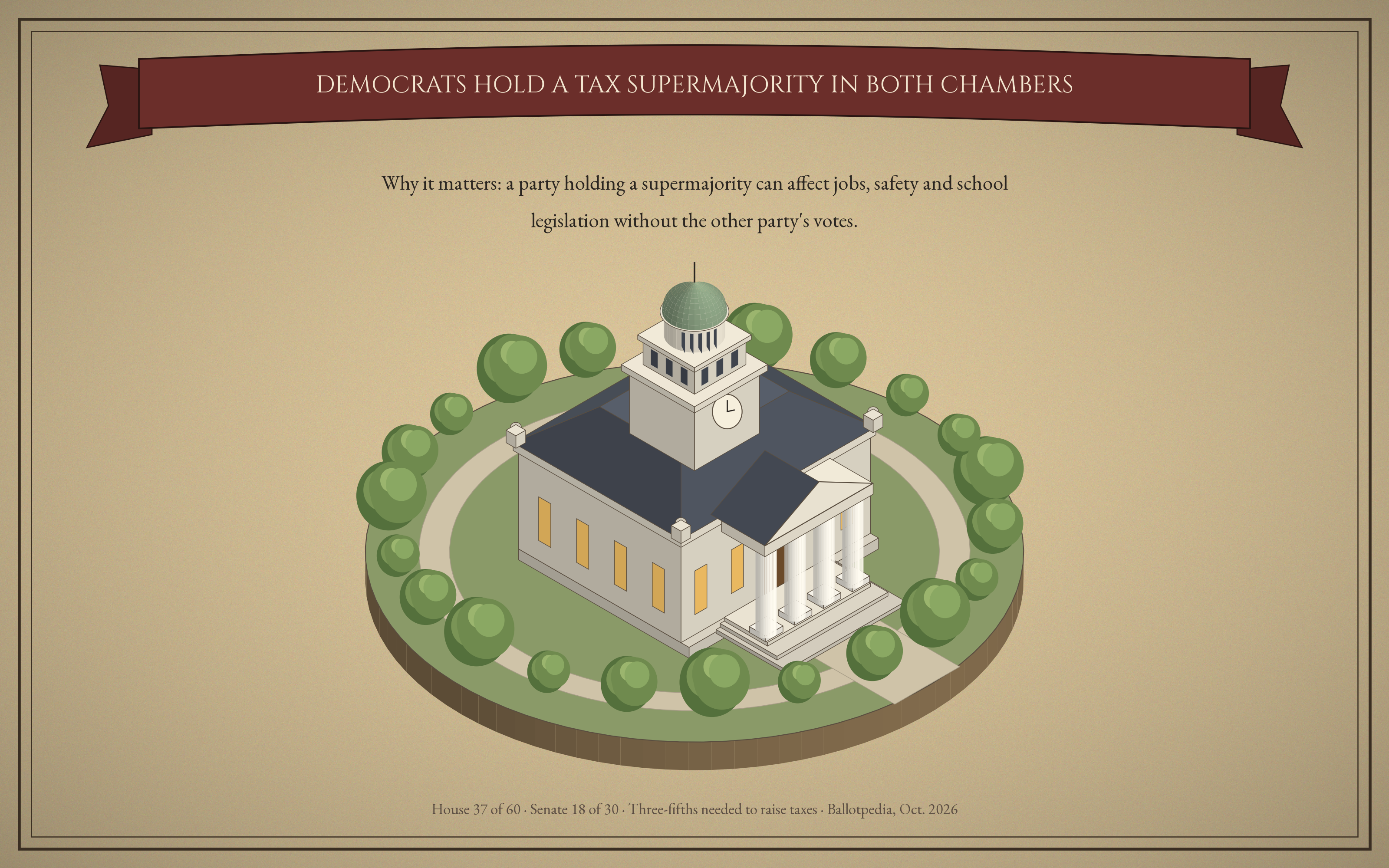
House 37 of 60 · Senate 18 of 30 · Three-fifths needed to raise taxes · Ballotpedia, Oct. 2026.
Neither candidate has put a number and a date on most of these levers. Drazan backs early literacy and ending social promotion by 3rd grade, paid for with Corporate Activity Tax money, with no date or target. Kotek backs more time, attendance and literacy, with one dated goal: national-average school hours by January 2031 (OPB, Sept. 17, 2026), after the term's last test. Neither candidate has said what result Oregon would see by 2030.
Don't take on more than you can run
A state that can't run its schools well shouldn't take on running health care. Oregon spends more per student than most states and gets 45th-place results. Before Salem or Portland builds a new health program, Oregon should show it can manage the schools it already pays for. My Portland health tax piece shows the cost at the top: under the board's October draft, a top-bracket Portland earner would keep about 39 cents of each extra dollar of wages.
The bottom line
The forecast isn't a verdict on either candidate. The forecast is a verdict on the campaign. An election matters to the middle when a candidate promises something the middle can measure. Oregon needs better reading scores, more police on the street and faster permits, counted every year, whoever wins.
Related: How Oregon recovers · Oregon in five years · The K-12 fix · Oregon unrest · The bottom-10 clock
Sources: my Oregon in Four Years series; Census Annual Survey of School System Finances FY2013/FY2024; NAEP; FBI 2024; Crowd Counting Consortium; Westall & Cummings 2023; Mississippi NAEP 2013–2024; OPB (Sept. 17, 2026); Drazan plan; Nickow, Oreopoulos & Quan 2020 (NBER w27476); Chalfin & McCrary 2018 (REStat); Bartik 2018 (Upjohn); Reed 2006; Portland Police Bureau staffing page (Oct. 9, 2026); Oregon Constitution Art. IV §25; Ballotpedia and Oregon Legislature roster (Oct. 2026).
Oregon in Four Years
- Oregon in Four Years, Part 1: Jobs. Who Wins Matters Less Than You Think
- Oregon in Four Years, Part 2: Safety. The Gap Is a Rounding Error
- Oregon in Four Years, Part 3: Schools. The Test Comes Too Soon
- Oregon in Four Years, Part 4: Will You Be Better Off?
- Oregon in Four Years, Part 5: What It Would Take
- Opinion: What Would Make This Election Matter to the Middle of Oregon (this page)
- Oregon Spent 89% More on Schools. Scores Fell to 45th.
--h
Questions or corrections? Write me at .