Oregon
Oregon's Health Plan Would Give Portland the Highest Tax Rate in America: 66%
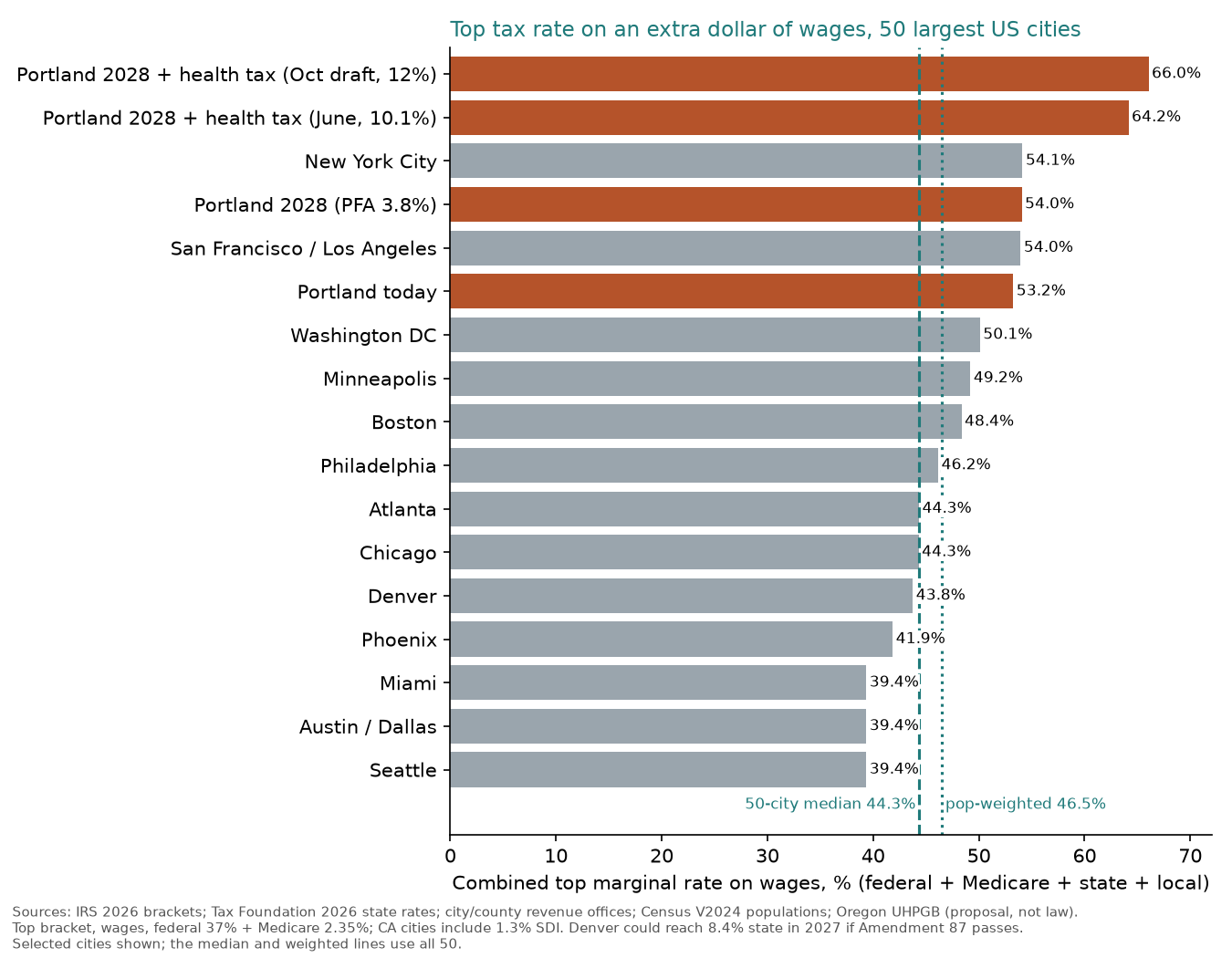
Among the 50 largest U.S. cities, counting federal tax, the proposed health tax would give Portland the highest top marginal rate on wages. The 66% comes from an Oct 5 draft the board hasn't approved; the June model gives 64%. The tax would replace premiums, so the effect on households is unknown.
Oregon's Universal Health Plan Governance Board is designing a statewide single-payer plan. Its financing would replace insurance premiums and most out-of-pocket costs with new taxes. It is a proposal, not law. The board's report is due Dec 1 2026, and the earliest full start is around 2032.
The taxes
The board's June model has a 10.1% health income tax on income above 200% of the poverty level. Employers would pay a 9.6% payroll tax on payroll above $500,000, and workers would get a credit for half of it. The Oct 5 draft, not yet approved by the board, raises the income tax to as much as 12%. Its payroll tax is either 9.89% or tiers of 9.6% and 14%.
The top rate
A top earner in Portland now pays 9.9% to the state, 1% for Metro's housing services tax and 3% for Multnomah's Preschool for All. Adding 39.35% federal brings an extra dollar of wages to 53.2% today, and 54.0% in 2028, when Preschool for All goes to 3.8%. Add the health tax and it's 64.2% under the June model and 66.0% under the October draft.
| Place | State + local | With federal |
|---|---|---|
| Seattle, Austin/Dallas, Miami | 0% | 39.4% |
| Chicago | 4.95% | 44.3% |
| Washington DC | 10.75% | 50.1% |
| Portland today | 13.9% | 53.2% |
| San Francisco / Los Angeles (with SDI) | 14.6% | 54.0% |
| New York City (highest of 50 today) | 14.78% | 54.1% |
| Portland 2028 + health tax (June) | 24.8% | 64.2% |
| Portland 2028 + health tax (Oct draft) | 26.7% | 66.0% |
| 50-city median / population-weighted | 4.96% / 7.18% | 44.3% / 46.5% |
Why "highest"
Today Portland ranks second of the 50 largest cities, behind New York at 54.1%. It ranks 11th if California's 1.3% SDI payroll tax counts. Either version of the health tax would put Portland 10 to 12 points above New York, the top city today, and about 20 points above the 50-city median.
What the rate leaves out
The rate only covers what a top earner pays on the next dollar of wages. Residents of other cities pay health premiums, and the plan would replace those for Oregonians. The board's documents don't publish a net estimate for a typical Portland household, so whether households would pay more or less in total is unknown.
What our research says
Across states, overall cost (prices plus taxes) tracks net migration, while tax burden alone is not significant once prices are held (Since 2020, Movers Went Where It's Cheaper). People leaving Oregon don't earn more per person than people arriving (Who Is Oregon Losing?). Evidence that Preschool for All pushed people out is contested. No U.S. city has had a top rate this high, so how high earners would respond isn't known.
--h
How we computed it.
- Federal: 37% top bracket plus 2.35% Medicare. Social Security is excluded because top earners are above its wage cap.
- SALT: state and local taxes are treated as not deductible. The 2026 SALT cap is $10,000 above about $606,000 of income, and the treatment is exact there.
- Excluded: employer and small payroll taxes. Oregon's 0.1% transit tax would add about 0.1 point.
- Comparison cities: use 2026 rates, including local wage taxes, and Census 2024 populations.
- Denver: could reach 8.4% in 2027 if Colorado's Amendment 87 passes.