Oregon in Four Years · Part 1
Oregon in Four Years, Part 1: Jobs. Who Wins Matters Less Than You Think
Oregon's Jobs rank will probably rise from 46th to the low 30s by 2029 whoever wins. My central forecast is about 32nd under Drazan and 34th under Kotek, if Democrats keep the Legislature. That 1–2 place gap falls inside a 37-place range of noise, and its own range includes zero.
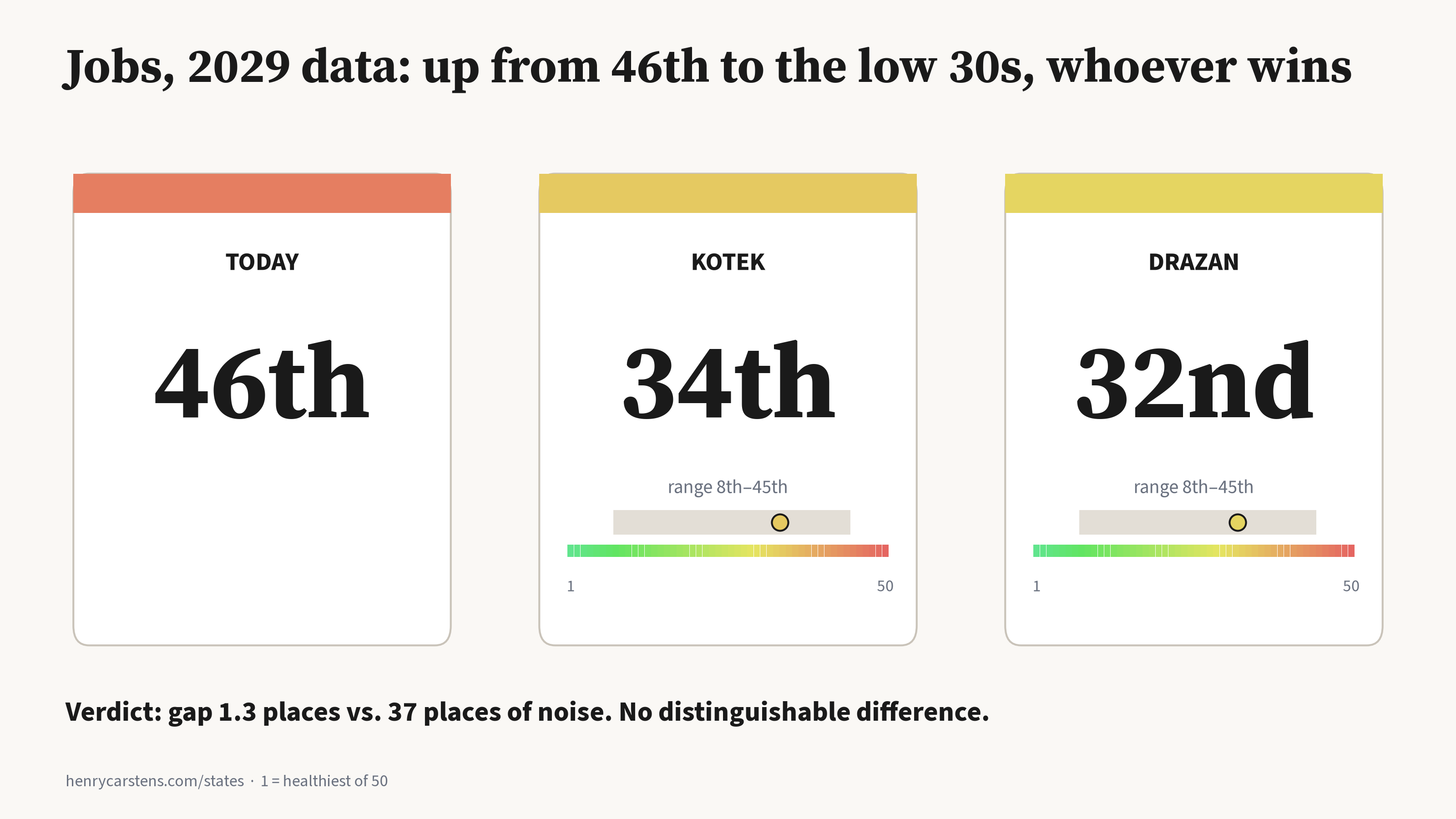
Bottom line: Oregon's Jobs rank will probably rise from 46th to the low 30s by 2029 whoever wins. My central forecast is about 32nd under Drazan and 34th under Kotek, if Democrats keep the Legislature. That 1–2 place gap falls inside a 37-place range of noise, and its own range includes zero. So there is no distinguishable difference.
Start from what this site already said
Before guessing what a governor will do, I checked what I've already published. The five-year plan said: "our forecast says the best guess for Oregon's rank three to five years out is today's rank, 47th... The likely range for 2029 is wide, roughly 32nd to 50th. So this is a plan, not a prediction." The recovery piece said: "Oregon's Jobs number mostly shapes whether it is in the bottom 10 next year." My forecast card warns that it "can't see policy, recessions..." and is "not a forecast of officials' performance."
So the site never said the candidates make no difference. It said ranks barely move in five years and that the forecast can't see policy. I take that as the null hypothesis: both candidates start from the same baseline, and one only pulls ahead where a lever has a measured effect that can land before the 2029 data.
Today's baseline
- Jobs rank: 46th of 50 (2024 data). The rank measures new business locations opened minus those closed, as a share of all private locations (BLS Business Employment Dynamics). Oregon's 2024 rate was −1.2%.
- Unemployment: 5.1% in Oregon vs 4.1% nationally (August 2026, BLS via FRED). That gap of about 1 point is wider than Oregon's average since 1990 (+0.5).
The trend if nothing changes (national baseline + Oregon's usual gap)
The Jobs rank is the noisiest thing I track. Only 45% of a state's position carries into the next year. A state in the bottom 10 gets to 22nd or better within two years 37% of the time. My backtested formula (next year's score = 17.5 + 0.31 × this year's − 0.71 × migration) pulls Oregon toward the middle:
| Data year | Central rank | 80% range |
|---|---|---|
| 2025 | 46th | 17th–48th |
| 2027 | 36th | 10th–45th |
| 2029 | 33rd | 8th–45th |
A word on that "80%": in real-time tests these ranges held only 65–75% of the time. Treat them as narrower than they really are.
Most of the coming improvement is mean reversion. Neither winner should get credit for it. The things that really move this number are national: a recession, interest rates, and whether Oregon keeps gaining people.
What a governor controls on jobs
Not much, alone. Tax bills need three-fifths of each chamber (Oregon Constitution Art. IV §25). Democrats now hold 37 of 60 House seats (one above the 36 needed) and exactly 18 of 30 Senate seats (Ballotpedia, Oct. 2026). Lose one Senate seat and the supermajority is gone. Democrats do not have the two-thirds needed to override a veto (Art. V §15b), so a Governor Drazan's veto of a tax bill would stick. But the Legislature can send a measure straight to voters, and the governor can't veto that (Art. IV §1(3)(c)). The new governor gets to revise Kotek's last budget (ORS 291.222; due Feb 1, 2027). The 2027 session's laws mostly take effect in 2028, which leaves about two years to show up in the 2029 data.
What the research says about governors and economies: - Leigh (2008), comparing close elections from 1941–2002: unemployment was about 0.29 points lower under Democratic governors (only at the 10% level). He finds nothing that survives correction for testing many outcomes, and concludes "governors behave in a fairly non-ideological manner." - Dynes & Holbein (2020): across unemployment, state GDP, business counts and more, 82 of 84 party effects are statistically zero. They can rule out effects bigger than about 0.2 standard deviations. - Reed (2006): tax levels follow the Legislature's party, not the governor's. - Beland (2015): Democratic governors raise hours worked for Black workers and narrow racial earnings gaps, but leave total employment about the same.
That same research is my cross-check. Leigh's 0.29 points leans Kotek. The lever math below leans Drazan. Oregon's gap to the U.S. unemployment rate typically swings by 0.9 points (one standard deviation) over any four years. Either signal is a third of that or less.
The levers, steelmanned
Each lever's delivered effect = chance it passes (given who holds the Legislature) × chance it's in force in time × effect size from a named study. Levers with no measured effect size are listed but count as zero.
Drazan. Her strongest jobs case: cut business taxes (reform the Corporate Activity Tax, now $250 plus 0.57% of sales above $1 million, and the estate tax, which starts at $1 million; raise the standard deduction), veto new taxes, freeze new regulation, repeal the Climate Protection Program, and create a $200M site-readiness fund. - Tax cuts. Her plan doesn't say how big. I assume they're worth about half a point of corporate tax rate. That's an assumption, chosen to be generous. Giroud & Rauh (2019, JPE) find about 0.5% fewer business locations per point of corporate tax. About half of that is firms moving between states, which is exactly what a state rank picks up. Ljungqvist & Smolyansky (2018) find tax cuts do little outside recessions. So the effect is 0 to +0.25 points on Oregon's net-opening rate. One rank place is about 0.035 points, so that's worth up to ~7 places, but only if it passes. Chance it passes: 25% with a Democratic three-fifths Legislature, 35% with a plain Democratic majority, 70% if Republicans win a chamber. Chance it's in force in time: 80%. - Regulatory freeze, site fund, permit timelines: no measured statewide effect within four years → 0. - Repealing the climate program: that's money (about $134 a person a year by 2030–31; see Part 4), but I find no link from energy prices to this rank (ρ = −0.11) → 0 places.
Kotek. Her strongest jobs case: enforceable statewide permit timelines, development-ready land, a new Department of Commerce, recruiting chip, clean-energy and life-science firms, and childcare and preschool to free parents to work. - Permit timelines, Commerce, recruiting: no measured statewide effect. Bartik (2018) finds incentives tip only 2–25% of location decisions → 0. - Childcare and preschool: real, but the payoff in parents' work comes too slowly and too unevenly for a 2029 business-openings rank → 0. - Paying for it: her plan names no tax. But a unified Democratic government that funds preschool and a longer school year may raise revenue. I assume that would be worth about a quarter point of corporate rate (my assumption). Ljungqvist & Smolyansky put the effect at −0.3 to −0.5% of employment per point. That gives 0 to −0.125 on the net-opening rate. Chance it passes: 40% with a three-fifths Legislature, 15% without it, 5% if Republicans win a chamber.
Headline forecast (2029 data, costs and benefits netted)
| Legislature after Nov 3 | Kotek | Drazan | Gap (80% range) | Distinguishable? |
|---|---|---|---|---|
| Democrats keep 3/5 in both chambers | 34th | 32nd | Drazan +1.3 (0 to +4.2) | No |
| Democrats keep majorities, lose 3/5 | 33rd | 32nd | Drazan +1.2 (0 to +4.8) | No |
| Republicans win a chamber | 33rd | 31st | Drazan +2.1 (0 to +5.9) | No |
The range of the noise if nothing changes is 8th to 45th, 37 places. The candidate gap is 11–16% of that. Every gap range touches zero, because there's a real chance neither lever passes. No distinguishable difference. Drazan's lean comes entirely from one lever whose size I had to assume.
Signposts to watch
-
Oregon minus U.S. unemployment. It's +1.0 now. If it falls below +0.3 by 2028, Oregon is recovering whoever is governor.
-
New business locations (BLS BED, quarterly). Openings rising for several quarters in a row is the leading sign for this rank.
- The 2027 tax bill. Check whether a CAT change passes, and how big it is. That alone sets most of the lean.
What would make this wrong
- A recession in 2027–29. That hits everyone, but Oregon's traded sectors (chips, timber) swing more. It would push the whole fan down. Note that Ljungqvist & Smolyansky find corporate tax cuts do help in recessions: employment rises about 0.6% per percentage-point cut, though cuts have no significant effect in expansions (NBER Working Paper 20753, Sec. 5.7, Table 8), so a recession is the one case where Drazan's lever gets bigger.
- A data quirk. In Oregon's 2024 data, closures may have been booked late (the business-deaths artifact I flagged before). If so, the true baseline is better than 46th and the climb looks smaller.
- My assumed sizes. If Drazan's tax cut is worth a full point, not half, her lean doubles to about 2.5 places. That's still inside the noise.
- The Legislature result on Nov 3, which isn't known yet. It matters about as much as the governor.
Sources: BLS BED and QCEW (site panel); FRED ORUR and UNRATE; states-formula backtest; Leigh 2008, European Journal of Political Economy 24(1); Dynes & Holbein 2020, APSR 114(1); Reed 2006, Journal of Public Economics 90; Beland 2015, AEJ: Applied 7(4); Giroud & Rauh 2019, JPE 127(3); Ljungqvist & Smolyansky, NBER w20753; Bartik 2018 (Upjohn); Kotek platform, Building Oregon's Future Together (campaign PDF, Sept 2026; OPB Sept 17, 2026); Oregon Capital Chronicle, final debate, Oct 13, 2026; The Drazan Plan (christinefororegon.com/drazan-plan, read Oct 2026); Oregon Constitution; ORS 291.222.
Oregon in Four Years
- Oregon in Four Years, Part 1: Jobs. Who Wins Matters Less Than You Think (this page)
- Oregon in Four Years, Part 2: Safety. The Gap Is a Rounding Error
- Oregon in Four Years, Part 3: Schools. The Test Comes Too Soon
- Oregon in Four Years, Part 4: Will You Be Better Off?
- Oregon in Four Years, Part 5: What It Would Take
- Opinion: What Would Make This Election Matter to the Middle of Oregon
- Oregon Spent 89% More on Schools. Scores Fell to 45th.
--h
Questions or corrections? Write me at .